Mix & Match Facial Filler — Your Way. Choose your brand, customize your look. 3–5 syringes starting at $1,600. June only. Book now
The wait is finally over, NYC. Come visit our new temporary home at Sola Salon (50 W 17th St). We can’t wait to see you!
Ready to fine-tune your look and feel your absolute best? Our interactive consultation is designed to make achieving your aesthetic goals effortless. Take our new treatment quiz
Botox for Men: What to Expect, Common Treatment Areas, and How to Get Natural Results
Table of Content
✕
Table of Content
Botox is no longer a treatment most men think twice about. In the United States, men now account for more than 500,000 neuromodulator procedures every year, and that number continues to climb. The reasons are straightforward: Botox is quick, requires no downtime, and when done by an experienced injector, produces results that look completely natural. No one needs to know unless you tell them. At Evolve Med Spa, we see men across all age ranges and backgrounds, from professionals looking to stay competitive in the workplace to guys who simply want to look as good as they feel. Here is everything you need to know about Botox for men at Evolve Med Spa — what it treats, how it works differently for men, what to expect, and how to get the most natural result possible.
Why Are More Men Getting Botox?
The short answer is that it works, and the stigma around men taking care of their appearance has largely dissolved. A few factors have driven the surge in men seeking neuromodulator treatment:
Workplace competitiveness: Looking sharp and well-rested has always mattered professionally, but the explosion of video calls has made men far more aware of how they present on screen. Forehead lines, a heavy brow, and deep frown lines can read as stressed or tired even when you are not — and in a competitive job market, that perception has real consequences.
Social media and dating apps: Profile photos matter more than ever. Men who are active on LinkedIn, dating apps, or social media are increasingly investing in their appearance the same way they invest in their wardrobe or fitness.
Low maintenance, high return: Unlike a surgical procedure, Botox takes 15 to 20 minutes, has no real downtime, and produces a refreshed result that colleagues and friends will notice without being able to place. It fits into a busy schedule without disrupting it.
Partner influence: A significant number of male clients at Evolve come in because a spouse or partner has seen their own results and suggested it. Once men see what a conservative treatment actually looks like, the hesitation usually disappears.
The goal for the vast majority of men is not to look dramatically different. It is to look like themselves — just less tired, less tense, and a few years fresher.
Is Botox Different for Men Than for Women?
Yes, in meaningful ways. Men and women have different facial anatomy, different muscle mass, and different aesthetic goals, and a skilled injector accounts for all of that.
Muscle strength and dosing
Men typically have larger, stronger facial muscles than women. This means men generally need more units of Botox to achieve the same degree of relaxation. A woman might need 10 to 15 units for her forehead; a man with the same surface area may need 15 to 25 units. Underdosing a male patient is one of the most common reasons men are disappointed with results they get elsewhere.
Aesthetic goals and placement
For women, a slightly elevated brow is often desirable. For men, a flat or horizontally positioned brow reads as more masculine and natural. Injecting too high on the forehead or at the wrong lateral point can feminize a man's appearance. Experienced injectors understand these differences and place product accordingly.
Treatment areas
The most requested treatment areas overlap substantially between men and women — forehead, frown lines, crow's feet — but men are also more likely to seek treatment for excessive sweating (hyperhidrosis) and are increasingly interested in jawline slimming and neck band treatment as awareness of those options grows.
What Are the Most Common Botox Treatment Areas for Men?
Forehead lines
Horizontal forehead creases are the most common concern for men seeking Botox, and for good reason. These lines form from years of raising the eyebrows and are one of the most visible signs of aging on the face. Treatment involves relaxing the frontalis muscle across the forehead. For men, we use a conservative approach that softens lines without flattening the brow too much or creating a heavy-lidded appearance.
Frown lines (the elevens)
The vertical lines between the eyebrows are caused by the corrugator and procerus muscles, which activate when you frown or concentrate. These are often the lines that make men look perpetually angry or stressed even when they are relaxed. A well-placed treatment in this area can open up the face significantly and is one of the highest-impact areas for men.
Crow's feet
The lines at the outer corners of the eyes are a near-universal concern for men in their 30s and beyond. Because men often spend more time outdoors and may have been less diligent about sun protection and moisturizer over the years, crow's feet can be among the more prominent aging indicators. Treatment here is precise and conservative — enough to soften movement without eliminating expression entirely.
Brow lift
A small amount of Botox placed strategically below the tail of the brow can create a subtle lift that opens the eye area without any surgery. For men whose brow has started to descend and is creating a hooded appearance, this can make a noticeable difference with very few units.
Jawline and masseter (jaw slimming and TMJ relief)
The masseter muscle at the corner of the jaw is one of the most popular off-label Botox applications for both men and women. For men, the treatment serves two purposes: it can slim a wide or square jawline for those who want a sharper, more tapered look, and it can significantly reduce grinding, clenching, and the headaches and jaw tension that come with bruxism. Learn more about masseter Botox for jaw slimming and TMJ relief.
Hyperhidrosis (excessive sweating)
Botox for excessive sweating is FDA-approved and highly effective for men who deal with significant underarm sweating that interferes with daily life or professional situations. A series of small injections into the underarm area blocks the nerve signals that trigger sweat glands. Results typically last 6 to 12 months, significantly longer than standard facial Botox, and the impact on quality of life for men who struggle with this condition can be substantial.
Neck bands (platysmal bands)
As men age, vertical bands on the neck can become more prominent, particularly in leaner individuals. Botox injected along these bands relaxes the platysma muscle and softens their appearance. This is a more advanced treatment best performed by an experienced injector, but it can meaningfully refresh the neck and jawline profile.
How Many Units of Botox Do Men Typically Need?
Because men have stronger muscles and larger treatment areas, unit counts for men run higher than the standard female dosing guides suggest. Here is a general reference:
Treatment Area
Typical Range (Women)
Typical Range (Men)
Forehead
8–15 units
15–25 units
Frown lines (elevens)
15–25 units
20–30 units
Crow's feet (both sides)
10–20 units
15–24 units
Brow lift
2–5 units
2–5 units
Masseter (both sides)
40–60 units
50–80 units
Hyperhidrosis (underarms)
50–100 units per side
50–100 units per side
Neck bands
20–40 units
25–50 units
These are general ranges. Your actual unit count will be determined at your appointment based on your muscle strength, the areas you want treated, and your desired result. A first appointment for a new male patient getting forehead, elevens, and crow's feet typically falls in the 40 to 60 unit range.
What Do Botox Results Look Like for Men?
The most important thing to understand about Botox for men is that the goal is not to look like you had anything done. It is to look like a well-rested, less-stressed version of yourself. Done well, no one will be able to tell.
Here is what to expect at each stage:
Days 1 to 3: No visible change. The product needs time to bind to the nerve endings at the muscle.
Days 3 to 5: You begin to notice reduced muscle movement in the treated areas. Lines look softer when you make expressions.
Days 7 to 14: Full results. Treated lines are significantly softer or gone at rest, and movement is reduced without being eliminated. The face looks fresh and rested without appearing frozen or overdone.
Months 3 to 4: Muscle activity gradually returns. Most men schedule a follow-up treatment at this point to maintain results. Some men find their results last closer to 4 months, particularly if they have been doing Botox consistently for a year or more.
One of the most consistent things we hear from male patients after their first treatment is some version of: people keep telling me I look great and they have no idea why. That is exactly the outcome we are aiming for.
What Happens at a Botox Appointment for Men?
If you have never been in for Botox before, here is what a first appointment actually looks like:
Consultation: We review your concerns, look at your facial movement, and discuss what treatment areas make sense for your goals. There is no pressure to do everything at once.
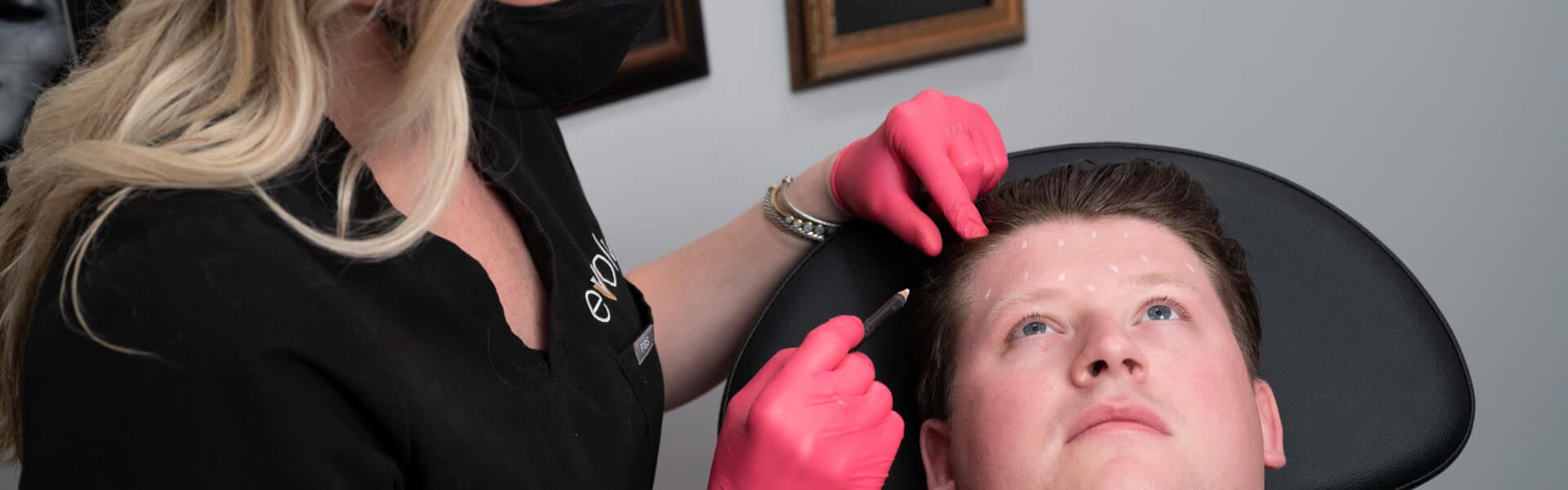
Mapping the treatment: Your injector will have you make several facial expressions to see how your muscles move and where lines form. This guides precise placement.
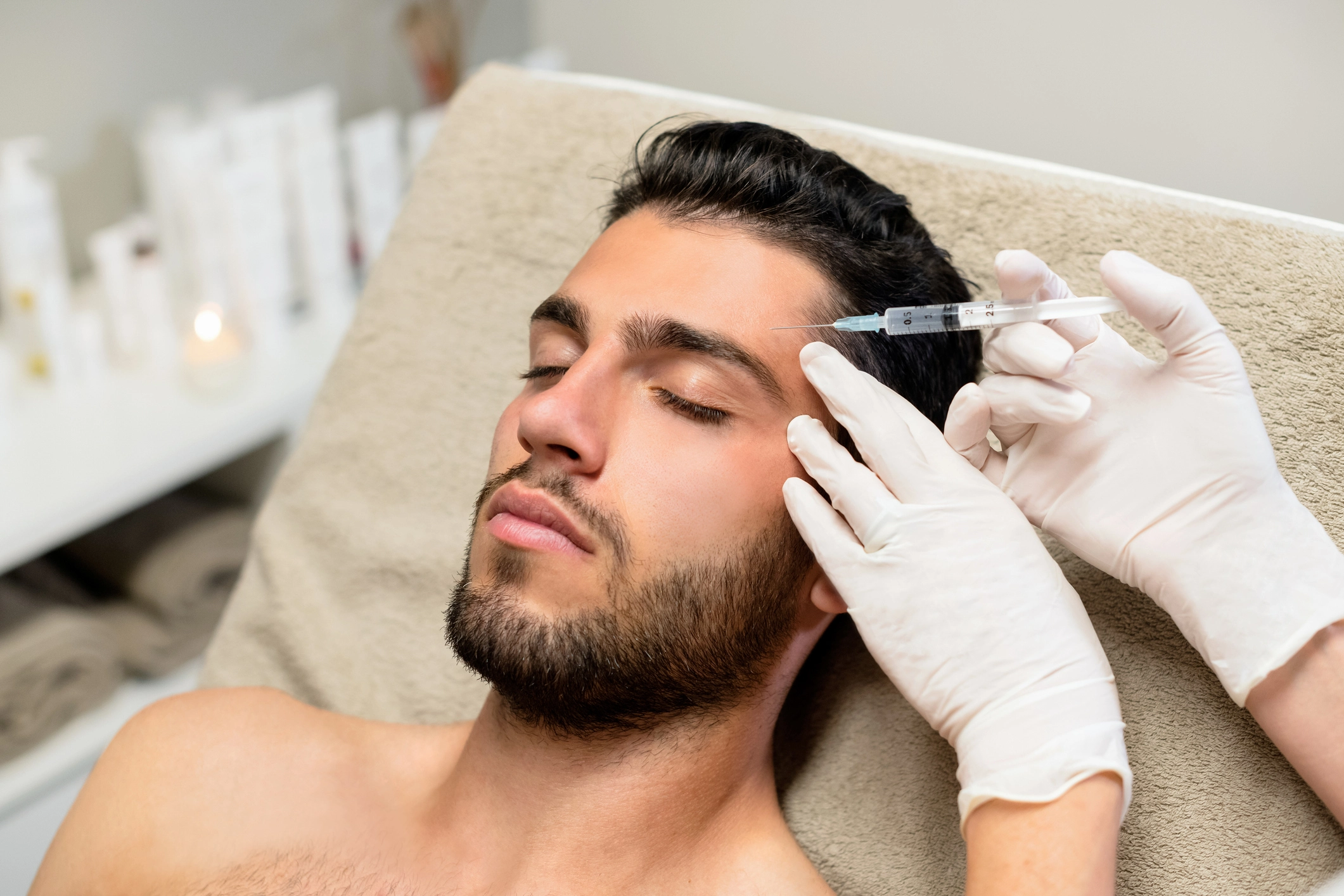
The injections: The actual treatment takes 10 to 15 minutes. Most men describe the injections as a minor pinch — the needles used are very fine and the treatment is well-tolerated without any numbing required.
Aftercare: You will be asked to avoid lying down flat, intense exercise, and rubbing the treated areas for the first few hours. Beyond that, you can return to your normal day immediately.
Results check: We encourage patients to come back at 2 weeks for a follow-up look. If any area needs a minor touch-up, we address it at that visit.
Most men leave the appointment and go directly back to work. There is typically no visible swelling, bruising, or redness that would draw attention.
How Often Should Men Get Botox?
The standard treatment interval is every 3 to 4 months. This is the point at which muscle activity typically returns enough that lines begin to reappear. Scheduling your next appointment before results have fully worn off is the most efficient approach — it keeps lines from deepening and means each treatment is maintaining rather than starting over.
Men who do Botox consistently over time often find that over the course of 1 to 2 years, the muscles gradually become less active, meaning results may start to last slightly longer. This is one of the compounding benefits of staying consistent rather than treating episodically.
Is Botox Safe for Men?
Yes. Botox (onabotulinumtoxinA) has one of the longest and most studied safety records of any aesthetic treatment. It has been FDA-approved for cosmetic use since 2002 and has been in clinical use for decades prior to that for neurological conditions. For healthy adult men, the risks associated with a properly performed cosmetic Botox treatment are very low.
The most common side effects are minor and temporary: slight redness or swelling at injection sites that resolves within a few hours, occasional mild headache after a first treatment, and in rare cases a small bruise at an injection point. More significant complications — such as eyelid drooping or brow asymmetry — can occur but are uncommon and temporary when they do, and are largely avoided by choosing an experienced, medically-trained injector.
At Evolve Med Spa, all Botox treatments are performed by licensed medical professionals with extensive experience in facial anatomy. We do not delegate injections to non-medical staff.
If you are thinking about when to start or how your approach might change over time, our decade-by-decade Botox age guide covers what a smart treatment plan looks like from your 20s through your 50s and beyond.
Frequently Asked Questions About Botox for Men
Does Botox hurt for men?
Most men describe the injections as a minor pinch or brief stinging sensation that lasts a second or two. The needles used are extremely fine. The vast majority of patients do not require or request any numbing. Treatment is well-tolerated and takes 10 to 15 minutes.
Will Botox make me look feminine or overdone?
Not when performed by an experienced injector who understands male facial anatomy. The key differences in technique for men — including brow placement, dosing, and which muscles are targeted — are specifically designed to preserve masculine features while softening lines. A natural result that does not change the fundamental structure of your face is absolutely achievable.
How much does Botox cost for men?
Because men typically require more units than women due to stronger muscles, the cost per appointment tends to be higher. Most practices charge per unit; the total depends on how many areas you treat and how many units are used. Your injector will give you a unit estimate at your consultation so you know what to expect before committing.
Can I work out after Botox?
We recommend avoiding intense exercise for the first 24 hours after treatment. Beyond that, there are no restrictions. Your normal workout schedule can resume the day after your appointment.
How long before a big event should I schedule Botox?
We recommend scheduling at least 2 weeks before any event where you want to look your best. Results typically begin showing at 3 to 5 days and reach full effect at 2 weeks. The 2-week window also allows time for a touch-up if any area needs adjustment.
What is the difference between Botox, Dysport, and Xeomin for men?
All three are FDA-approved botulinum toxin type A neuromodulators that work the same way. The differences are in formulation, dosing ratios, and onset speed. Dysport tends to spread slightly more and may onset faster; Xeomin contains no accessory proteins, which can be an advantage for long-term users. We offer all three and will recommend the best option for your anatomy and goals. Learn more about how Dysport and Xeomin compare to Botox.
Is there a right age for men to start Botox?
There is no universal right age. Men in their late 20s with strong frown lines or forehead creases can benefit from a conservative preventative approach. Most men start in their 30s or 40s when lines become more noticeable. There is no upper age limit — men in their 50s and 60s see meaningful results from treatment, particularly when combined with other treatments that address skin laxity and volume loss.
Do I need to tell anyone I am getting Botox?
Not at all. One of the most appealing things about Botox is that it requires no visible recovery and produces results subtle enough that most people cannot tell you have had anything done. Many of our male patients have been coming for years without family or colleagues being any the wiser.
Ready to See What Botox Can Do for You?
Evolve Med Spa serves men across New Jersey and Pennsylvania with expert, medically-supervised Botox treatment in a comfortable, judgment-free environment. Whether you have specific areas in mind or want a full consultation to talk through your options, we are here to help you figure out the right approach. Book your consultation at Evolve Med Spa and take the first step.
Let’s keep in touch! Sign up to our newsletter and receive 10% off your first treatment with us!
Explore
This website may convey general information related to medical conditions, their research, testing, and treatment, and other health care topics. Any such information is provided for informational purposes only. You should always consult with a doctor or other health care professional for medical advice or information about diagnosis and treatment.