Mix & Match Filler — Choose your brand, customize your look. As low as $475/syr. Book Now
Refer friends right in the Evolve app — you both earn $50 in credit. Refer now
Radiesse BBL: Lift, shape, and projection without surgery. Starting at $2,750. Book now!
The wait is finally over, NYC. Come visit our new temporary home at Sola Salon (50 W 17th St). We can’t wait to see you!
Ready to fine-tune your look and feel your absolute best? Our interactive consultation is designed to make achieving your aesthetic goals effortless. Take our new treatment quiz
How Many Botox Units Do You Need for the Forehead?
Table of Content
✕
Table of Content
"How many units will I need?" is one of the first questions most people ask before their first Botox appointment, and it's a great one to ask. The answer isn't one-size-fits-all, but there are well-established clinical guidelines that give a clear ballpark. This guide breaks down standard dosing for forehead Botox, how providers determine the right amount for you, and what factors can shift those numbers.
How Many Units of Botox Does a Forehead Typically Need?
Standard dosing guidelines for the main forehead zones:
Treatment Area
Typical Units
Notes
Horizontal forehead lines
10–20 units
More for larger foreheads
Glabellar lines ("11s")
20–40 units
Men often need more
Brow lift (lateral brow)
2–6 units
Often combined with forehead
These are guidelines, not rules. Your actual dosing will be determined by your provider based on a clinical assessment of your muscle mass, movement patterns, and the depth of your lines.
What Are the "11 Lines" and How Many Units Do They Need?
The glabellar lines, the vertical creases between the eyebrows, are called the "11 lines" because they form two parallel vertical lines. They're caused by repeated contraction of the corrugator supercilii and procerus muscles. The FDA-approved dose for Botox in the glabellar region is 20 units for women and up to 40 units for men with stronger corrugator muscles.
Yes, significantly. Men generally have larger, stronger facial muscles than women, particularly in the forehead and glabellar region. Men typically require 20 to 40% more units to achieve the same degree of relaxation. This is normal physiology, not a sign of tolerance.
Your provider will assess several factors when determining your treatment plan:
Muscle mass and strength: Larger, more active muscles require more product
Depth of existing wrinkles: Deep, established lines often require more units
Desired effect: Complete relaxation vs. softened natural movement
Prior treatment history: Regular Botox patients often require fewer units over time
Facial anatomy: Forehead size, brow position, and muscle insertion points
Can You Get Too Much Botox in the Forehead?
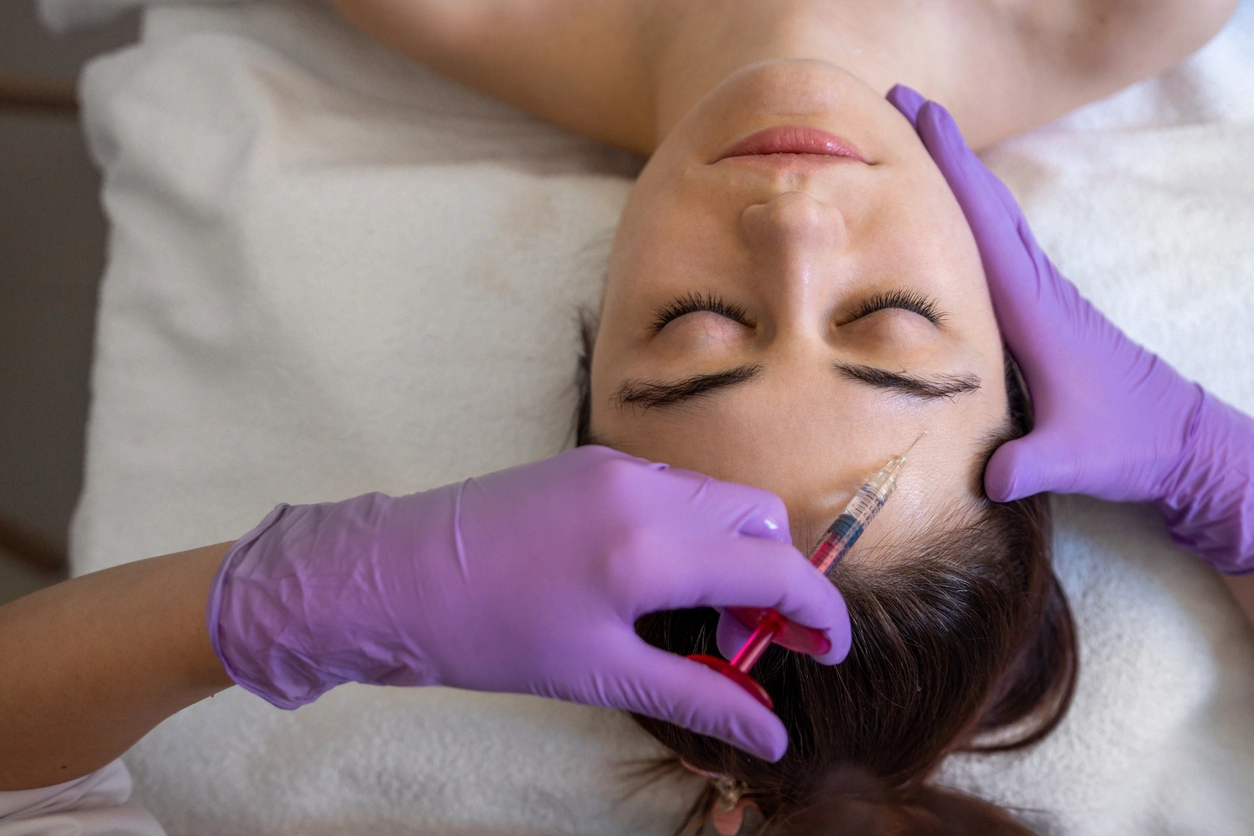
Yes, over-treating the forehead is one of the most common Botox mistakes. Using too many units or injecting too low on the forehead can cause brow ptosis (drooping eyebrows), a heavy sensation in the forehead, and an inability to raise the brows. This is why it's important to work with an experienced injector who takes a conservative, anatomy-first approach.
In most cases, yes. The frontalis muscle (forehead lines) works in opposition to the glabellar muscles (11s). If you treat only the forehead without also treating the glabellar region, you can inadvertently cause brow heaviness. Treating both areas in concert produces more balanced, natural-looking results.
Frequently Asked Questions About Forehead Botox
How many units of Botox are in a syringe?
Botox comes in vials of 50 or 100 units, which are diluted by the provider before injection. What matters is the number of units injected into your specific treatment area, not the volume of the syringe.
Is 20 units of Botox enough for the forehead?
For many patients with moderate forehead lines, 20 units is a reasonable starting dose. However, if you also treat the glabellar region (which most providers recommend), your total forehead treatment will be higher, often 30 to 50 units combined.
How do I know if I got enough Botox?
At two weeks post-treatment, you should be able to assess your results. If you still have full muscle movement in the treated area, it's possible you were under-dosed. Communicate this to your provider at your follow-up; many providers include a free two-week touch-up.
Does Botox for forehead lines hurt?
Most patients describe forehead Botox as a series of small pinches. The needles used are very fine, and treatments are quick, typically under 10 minutes. Numbing cream can be applied beforehand if you're concerned about sensitivity.
Wondering how many units you'll need? Book a Botox consultation at Evolve Med Spa and our expert injectors will assess your anatomy and create a dosing plan designed for your specific goals.
Our Locations
Find Your Nearest Evolve
14 clinics across New Jersey, New York, Maryland & Pennsylvania. Choose yours for hours, directions and treatments.
Let’s keep in touch! Sign up to our newsletter and receive 10% off your first treatment with us!
Explore
This website may convey general information related to medical conditions, their research, testing, and treatment, and other health care topics. Any such information is provided for informational purposes only. You should always consult with a doctor or other health care professional for medical advice or information about diagnosis and treatment.